Last year, while travelling through ex-Soviet Central Asia, I was exposed to a region in which profound cultural and economic change is enfolding in varied and fascinating ways. In Western Europe, our exposure to the region has until recently been resting entirely on the cultural stereotyping of Borat, or a general idea of post-Soviet decline and conflict which has been across news stories since 1991. Yet in recent years, ex-Soviet central Asia has seen somewhat of a renewed emergence in the western consciousness, particularly among my own generation.
Prior to my travels, my sense of adventure and exploration was colored heavily by my own cultural background. For a young English person, especially someone always engrossed in history, Central Asia occupied a unique mysticism. Through reading about the inevitably colonial exploits of British and Russian agents in Peter Hopkirk's the Great Game or simply imagining the vast and seemingly primordial landscapes occupying the blank areas on Google earth between the Caspian and China, the region gained a particular significance to me.
One of my experiences in particular embodied this. During the final weeks of my travels, after already travelling through Georgia, Uzbekistan and Kazakhstan, I found myself in Kyrgyzstan. While staying at a dirt-cheap hostel in the mountain town of Karakul, I met another British traveler who had a contact for a guide to visit the abandoned Soviet mining town of Engelchek situated in the Sary Jaz region. It had been constructed post-second world war around a tin mine, which had since closed following Soviet collapse, leading to the exodus of 5,000 of the town's inhabitants. In 2025 during my visit, only around 20 families still lived in the village and its surroundings. We met our guide Jaidar, who arrived in the early morning at our hostel in a 4x4.
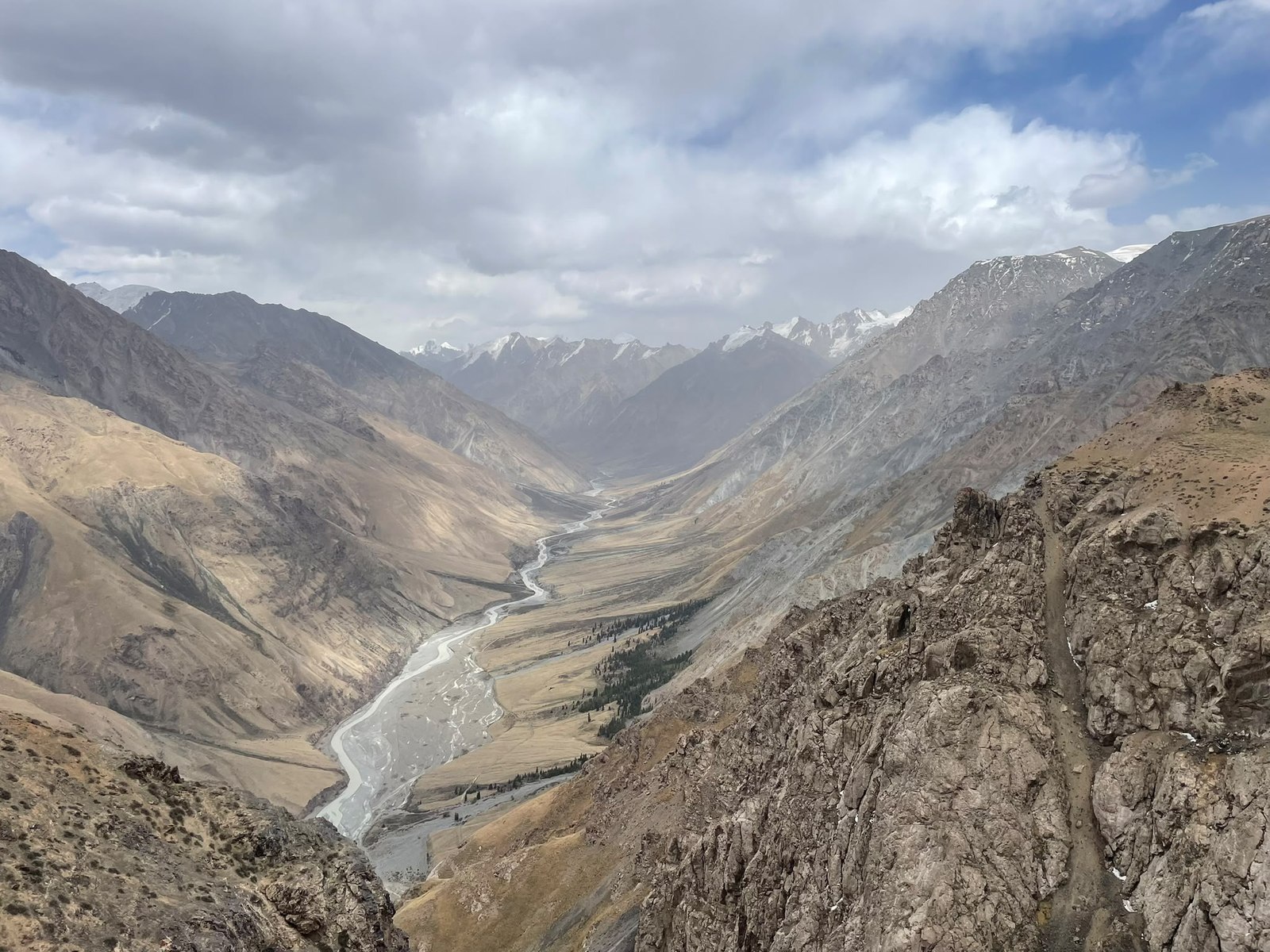
The first day of travel took us over a high mountain pass at 4000 meters dividing the lush alpine slopes of Altin-Arashin from the bare and rugged valleys of the Sary Jaz border region. The mountains surrounding us were immense slopes of rock, layered with grey, brown and red, with ice caps almost invisible above. The town itself was largely empty, with abandoned soviet blocks and several smaller one-story buildings. Far above the town, trucks still carried the remaining dregs of tin from the mine, snaking their way down. What struck me most was the complete lack of green anywhere in the valley.
The grass, trees, rock and even the water all possessed the same sultry shade of grey brown, as if the entire landscape had died and lay stupefied in the still dry air. It created a strange impression upon me. There were few signs of green and running water in the sterile landscape – the few small streams running off the mountains cutting through the bare earth left trails of green grass in their wakes, appearing dazzlingly fecund among the brown and grey. My eyes seemed to focus automatically on these undeniable signs that I was, still, standing on the surface of Earth, not the moon. Yet simultaneously, there remained a clarity in the uncluttered towering valley walls and broad rock-strewn floor, which it seemed was what I had longed for throughout my travels. Nowhere before had so embodied the vision of emptiness and grandeur that my mind had imagined, and it gave me a profound satisfaction to know that I had at last encountered what seemed to me to be the primordial and prehistoric.
Rather than staying at Jaidar's home in the town itself, we drove another two hours on unmade road to his farm, situated at the end of the valley on a wide grassy valley river plane. The farm constituted a small bungalow with outbuildings and a soviet-era campervan in which my friend and I slept. His wife and one of his sons were waiting for him. While Jaidar's home remained truly at the edge of civilization, it was nonetheless infused with signs of the wider world. During the summer months, Jaidar acts as the guide for Russian and American hunters who shoot a particularly elusive breed of elk in the Sary Jaz. This business had made him an exceptionally prosperous figure in the area. He owned many horses, several cars, and houses both in the valley and back in the larger populated town of Karakul and had afforded the exceptional luxury by Kyrgyz standards of a brand-new iPhone. He frequently posted videos and photos of his business, building an online presence as the foremost guide of the area.
For me, his home and its surroundings represented an exotic source of fascination – however for Jaidar it represented primarily a logistical nightmare. Living on the edge of human contact required relentless effort, where all food, supplies and people had to be transported along borderline impassable roads often, as we found on our way down the valley, blocked with boulders as large as the car itself. During our first evening, Jaidar sent his twelve-year-old son galloping into the creeping darkness, armed with a rifle. After an hour he returned, with a grisly photograph of a horse's corpse ripped open across its belly, inflicted by wolves. Our first day on the farm was spent riding for hours up into the foothills of the mountains to retrieve several more lost horses, which were herded back down into the valley with considerable difficulty.
There was a moment that afternoon when from the top of a ridge high above the farm we spotted the gleaming head of Khan Tengri, a 7000-meter peak, rise above the grey mass of mountains on the horizon. I made it clear to Jaidar that I aimed to climb it and other mountains like it one day, on a later trip to the region. But Jaidar, of course, had been to the basecamp of the mountain, and made it clear his opinion. It served no purpose to climb, and it was an unacceptable risk for a man with a family and responsibilities.